
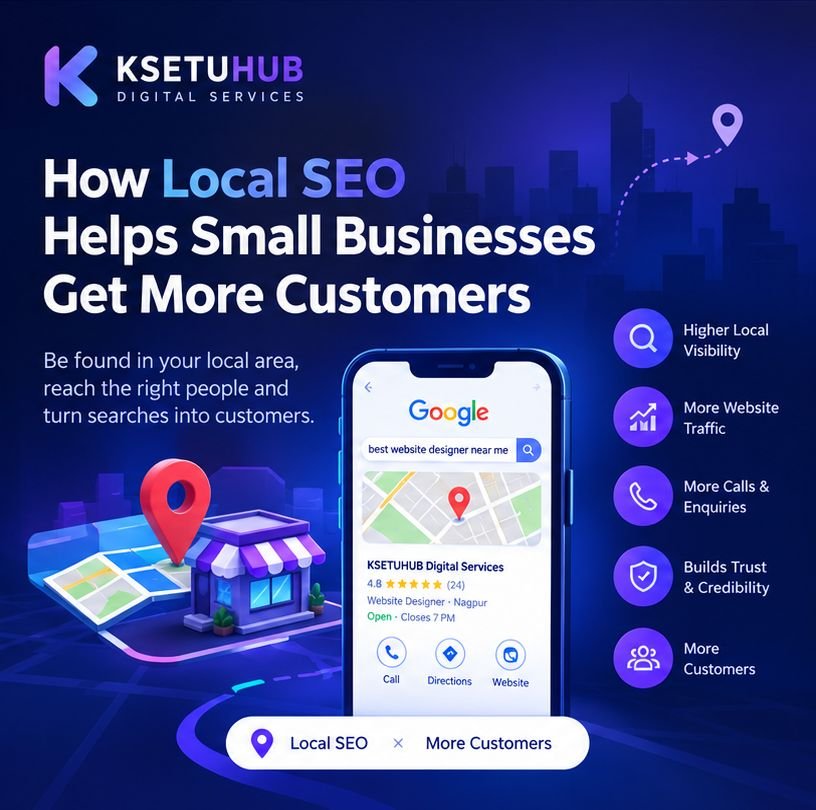
How Local SEO Helps Small Businesses Get More Customers
When people need a nearby service, they often search online before deciding which business to contact. They might search for a website designer in Nagpur, a restaurant near them, a local electrician, or a digital marketing agency in their city.
If your business does not appear prominently in relevant local search results, potential customers may discover your competitors instead.
This is where local search engine optimization, commonly known as local SEO, becomes valuable. Local SEO helps businesses improve their visibility for searches connected to a particular location and reach people who are looking for relevant products or services.
In this guide, we explain how local SEO works and what small businesses can do to build a stronger local online presence.
1. What Is Local SEO?
Local SEO is the process of improving a business’s online presence to help it appear in relevant location-based search results.
For example, a business serving Nagpur may want to appear when someone searches for website development services in Nagpur.
Local SEO can involve optimizing your website, maintaining your Google Business Profile, managing business information across relevant directories, earning genuine customer reviews, and publishing useful location-relevant content.
The objective is not simply to attract more website visitors. It is to help the right people discover your business when they are looking for the services you provide.
2. Optimize Your Google Business Profile
A Google Business Profile can help eligible businesses appear in Google Search and Google Maps.
An accurate and complete profile makes it easier for customers to learn about your business, view your operating hours, find your location, and contact you.
Important details to review include:
- Your correct business name.
- The most appropriate primary and additional categories.
- Accurate business hours and contact information.
- A clear description of your services.
- Genuine photographs of your business or completed work.
- Your website link and relevant service information.
Keep the information accurate and update it whenever your business details change.
Avoid adding promotional keywords to your business name unless they are genuinely part of the real-world business name. Accurate information is better for customers and helps you follow Google’s guidelines.
3. Use Location-Relevant Keywords on Your Website
Your website should clearly communicate what your business does and which areas it serves.
For example, a website development company serving Nagpur might create a service page explaining its website design, WordPress development, or website maintenance services for local businesses.
Useful location-relevant phrases may include:
- Website development services in Nagpur.
- WordPress website maintenance in Nagpur.
- SEO services for small businesses.
- Digital marketing services for local businesses.
Use these phrases naturally in page titles, headings, service descriptions, and relevant page content.
Avoid repeating the same keyword excessively or creating dozens of nearly identical pages for different locations. Each page should offer meaningful information for its intended audience.
4. Create Dedicated Service Pages
A website with only a homepage may not provide enough detail about all the services a business offers.
Dedicated service pages allow you to explain each service in greater depth, describe the problems it solves, answer common questions, and provide a clear way to enquire.
For example, a digital services business might create separate pages for:
- Website design and development.
- Search engine optimization.
- Website maintenance.
- Server management.
- Google Business Profile support.
Each page should have a descriptive title, useful original content, relevant internal links, and a clear call to action.
This structure helps potential customers understand your offerings and gives search engines clearer information about the subjects covered by your website.
5. Keep Your Business Information Consistent
Customers may encounter your business on your website, Google Business Profile, social media pages, and business directories.
When important details differ across these platforms, customers may become confused.
Review your business name, phone number, website URL, address or service area, and opening hours wherever they are published.
Correct outdated listings when possible, and prioritize reputable platforms that are relevant to your industry and location.
You do not need to submit your business to every directory available online. Focus on accuracy, relevance, and genuine value to potential customers.
6. Encourage Genuine Customer Reviews
Customer reviews can help people understand other customers’ experiences and make more informed decisions.
Businesses can encourage customers to leave honest feedback after completing a service or purchase. Make it easy by sharing the appropriate review link and politely asking for feedback.
Respond professionally to both positive and negative reviews. Thank customers for their feedback, address legitimate concerns, and avoid sharing private customer information in public responses.
Never buy fake reviews or offer incentives in exchange for positive ratings. Reviews should reflect genuine customer experiences and comply with the platform’s policies.
7. Make Your Website Mobile-Friendly
Many people discover local businesses using mobile devices. If your website is difficult to navigate on a phone, visitors may leave before contacting you.
A mobile-friendly website should have readable text, appropriately sized buttons, responsive layouts, fast-loading pages, and easy-to-find contact information.
For businesses that receive enquiries by phone or WhatsApp, clear contact options can make it easier for visitors to take the next step.
Test your website on different screen sizes and regularly check that enquiry forms, phone links, and navigation menus work correctly.
8. Publish Helpful Local Content
Useful content can answer questions that potential customers have before choosing a service provider.
For example, a website development business could publish articles about website costs, choosing a domain name, maintaining a WordPress website, or improving website speed.
A business serving a particular city can also publish relevant local guides when it has genuine expertise or useful information to share.
Focus on answering real customer questions instead of creating articles solely to repeat keywords. Include relevant internal links to your service pages where they help readers.
Consistent, helpful content can build credibility and support your broader SEO strategy over time.
9. Improve Website Speed and Technical SEO
Search engines need to access and understand your website, while visitors need a smooth browsing experience.
Technical SEO involves maintaining a website structure that supports crawling, indexing, usability, and performance.
Important areas include:
- Descriptive page titles and meta descriptions.
- A logical heading structure.
- Working internal links.
- A valid XML sitemap where appropriate.
- Correct handling of redirects and broken pages.
- Mobile usability and page performance.
- Appropriate image optimization and alternative text.
- Secure HTTPS connections.
Technical improvements alone do not guarantee high rankings, but they help establish a healthier foundation for your website.
10. Track Results and Improve Your Strategy
Local SEO is an ongoing process. Tracking results helps you understand which activities are useful and where improvements may be needed.
Google Search Console can help you review search queries, impressions, clicks, and indexing information. Google Business Profile performance data may also provide useful information about how customers discover and interact with your profile.
Monitor relevant enquiries, calls, website visits, and conversions where tracking is available.
Do not judge success by rankings alone. The more important question is whether your online presence is helping your business attract relevant customers and generate meaningful enquiries.
11. How KSETUHUB Can Help With Local SEO
KSETUHUB Digital Services supports businesses that want to strengthen their online presence through website development, SEO, website maintenance, and Google Business Profile assistance.
Depending on your needs, support may include website SEO improvements, service-page optimization, technical website checks, local business information updates, and recommendations for improving your online visibility.
A suitable strategy starts with understanding your business, target customers, services, and service area. From there, the focus should be on making your business easier to discover and helping visitors understand why they should contact you.
Conclusion
Local SEO can help small businesses become more visible to people searching for relevant services in their area. By optimizing your Google Business Profile, improving your website, maintaining accurate business information, collecting genuine reviews, and publishing helpful content, you can build a stronger local presence.
Results take time and depend on factors such as competition, relevance, distance, and the quality of your online presence. Consistent improvements are more sustainable than shortcuts or promises of guaranteed rankings.
Want to improve your business’s online visibility? Contact KSETUHUB Digital Services to discuss SEO, website optimization, and Google Business Profile support.
Start by making it easier for the right customers to find your business and take the next step.